

Civil Engineering

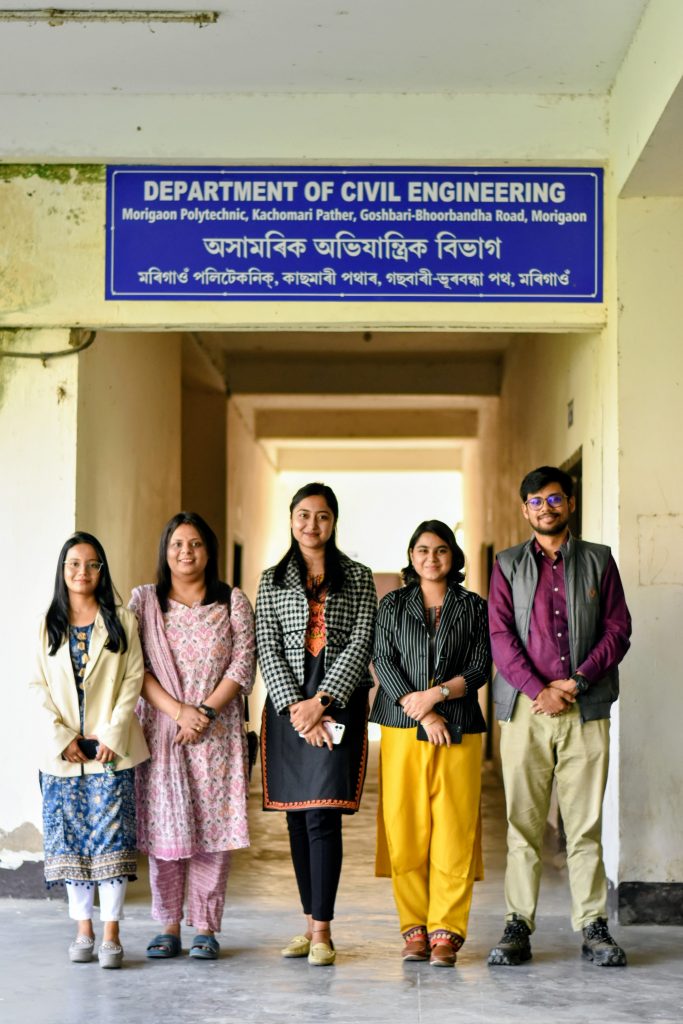
The Civil Engineering Department of Morigaon Polytechnic was established in 2020, as part of the 2020–21 academic session. Since its inception, the department has been dedicated to providing strong technical education that combines sound theoretical knowledge with practical, field-oriented learning.

The department covers core civil engineering domains starting from the Foundation of any structure understanding the mechanics of soil to Structural analysis and design of both RCC & steel structures; Transportation to railway to airport engineering; Environmental Engineering; Water Resources and Construction Technology. With well-equipped laboratories, modern surveying instruments, and a team of qualified and committed faculty members, the department ensures that students gain hands-on training and industry-relevant skills.

Frequent fieldwork, practical sessions, and exposure to real-world engineering practices help students develop technical competence, problem-solving abilities, and confidence. The department strives to create a productive and supportive learning environment where students can grow academically and professionally.

Through its focus on practical application and holistic skill development, the Civil Engineering Department of Morigaon Polytechnic prepares students to meet the evolving needs of the construction and infrastructure sectors.

VISION

To produce technically competent and socially responsible civil engineers capable of contributing to sustainable infrastructure development.

MISSION

To impart quality civil engineering education through practical training, industry exposure, and ethical professional development to meet the needs of the construction and infrastructure sectors

Sr. No Equipment Present Description
1 Chain (Metric Chain) Used for linear measurement; made of galvanized mild steel links of 20 cm or 10 cm. Available in 5 m, 10 m, 20 m, 30 m lengths.
2 Engineer’s Chain 30 m long chain with 100 links (each 0.3 m); used for engineering surveys.
3 Measuring Tape Flexible steel or fiberglass tape marked in metric units, used for direct linear measurements (5 m–100 m).
4 Arrows Steel pins (40 cm × 4 mm) used to mark the end of a chain length during measurements.
5 Ranging Rods Wooden, bamboo, or metal rods (2 m or 3 m) painted alternately red, white, and black; used for ranging straight lines.
6 Cross Staff Used to set out right angles in chain surveying; consists of brass head with four vertical slits at 90°.
7 Plumb Bob Conical brass or steel weight suspended by a thread; used for vertical alignment.
8 Prismatic Compass Portable magnetic compass with a prism for reading bearings directly.
9 Theodolite Precision instrument used for measuring horizontal and vertical angles
10 Total Station Combines EDM and theodolite for electronic angle and distance measurement with digital data storage.
11 Tripod Three-legged wooden or aluminum stand used to support surveying instruments like theodolite or level.
12 Dumpy Level Optical instrument with a fixed telescope used to establish horizontal line of sight for leveling.
13 Auto Level Leveling instrument with compensator for automatic horizontal line of sight adjustment.
14 Spirit Level Sealed glass tube partially filled with spirit; used for checking horizontality or verticality.
15 Alidade Sight rule with vanes or telescope used on plane table for sighting and plotting survey lines.
16 Plane Table Drawing board mounted on tripod; used for field plotting of survey details directly.
17 Plane Table Tripod Tripod made of seasoned wood or aluminum; provides support and leveling to the plane table.
18 U-Fork (Forked Stand) Metal fork with plumb bob used to transfer ground points to plane table station.
19 Trough Compass Narrow rectangular magnetic compass used for orienting the plane table to magnetic north.
Sr. No Equipment Present Description
1 Core Cutter A cylindrical steel cutter used to determine the in-situ bulk density of cohesive soils.
2 Dolly A steel cap placed on top of the core cutter to protect it while driving into the soil.
3 Sand Replacement Assembly Consists of a sand pouring cylinder, calibrating container, and tools used to determine the in-situ density of soil by the sand replacement method.
4 Steel Rammer A compaction hammer used for compacting soil in various tests.
5 Balance A weighing device used for accurate measurement of soil, water, and container weights.
6 Containers to Determine Moisture Content Airtight metal containers used to store soil samples during moisture content determination.
7 Pycnometer A glass vessel used for determining the specific gravity of soil solids.
8 Scoop A small metallic tool used for transferring soil samples conveniently.
9 IS Sieves (4.75 mm to 75 µ) & Pan (2 sets) Standard sieves used for separating soil particles of different sizes for grain size analysis.
10 Casagrande’s Apparatus A device with a brass cup and cam mechanism used to determine the liquid limit of soils.
11 Grooving Tool (Spatula) A tool used to cut a standard groove in the soil sample placed in the Casagrande cup.
12 Mixing Dish A flat-bottomed dish used for mixing soil and water during sample preparation.
13 Ground Glass Plate for Rolling and Specimen Preparation A smooth glass plate used for rolling soil threads while performing the plastic limit test.
14 Proctor Mould with Detachable Collar & Base Plate A cylindrical steel mould used for determining the optimum moisture content and maximum dry density of soil.
15 Rammer A steel hammer used to compact soil in a mould during compaction tests.
16 Direct Shear Box Apparatus Equipment used to determine the shear strength parameters of soil under different normal loads.
17 Palette Knife A flexible steel knife used for trimming and handling soil specimens.
18 Universal Testing Machine (UTM) A versatile machine used to test materials under tension, compression, and bending.
19 CBR Testing Machine A machine used to determine the bearing strength of soil for road and pavement design.
20 Permeability Meter Apparatus used to measure the rate of flow of water through soil and to determine its coefficient of permeability.
Sr. No Equipment Present Description
1 Bernoulli’s Theorem Equipment Used to verify Bernoulli’s theorem by demonstrating the relationship between pressure head, velocity head, and potential head in a flowing fluid.
2 Discharge over Notch Apparatus used to measure the discharge of water over various types of notches such as rectangular or V-notch to study flow measurement techniques.
3 Reynolds Apparatus Used to demonstrate the types of fluid flow—laminar, transitional, and turbulent—by observing dye patterns in a glass tube.
4 Losses Due to Pipe Fittings Equipment used to determine the head losses that occur in various pipe fittings like bends, elbows, and valves.
5 Losses Due to Friction Apparatus designed to measure the head loss caused by friction in pipes of different diameters and lengths.
6 Water Tank A storage tank used to supply water to various experimental setups and maintain a steady flow rate.
7 Hydraulic Bench A self-contained water circulating system that provides controlled water flow for conducting multiple hydraulic experiments.
8 Flow Meter An instrument used to measure the rate of flow of water or any fluid through a pipe or channel accurately.
Sr. No Equipment Present Description
1 Balance Used for accurate weighing of materials such as cement, fine and coarse aggregates. Precision varies depending on use (0.1 g or 1 g accuracy).
2 IS Sieves (4.75 mm, 2.36 mm, 1.18 mm, 600 µ, 300 µ, 150 µ, 75 µ & Pan) Used for particle size distribution analysis (sieve analysis) of aggregates and soils. Made of brass or stainless steel.
3 Temping Rod Steel rod used for compacting concrete or soil in layers. Typically 16 mm diameter and 600 mm long with rounded ends.
4 Glass Plate Smooth, thick glass plate used as a non-porous base for testing cement paste or mortar consistency.
5 Trowel Steel tool with a flat blade used for mixing or applying mortar or cement paste during tests.
6 Measuring Cylinder Graduated glass or plastic cylinder used for accurate measurement of liquid volumes.
7 Bowl Non-corrosive mixing bowl (usually of enamel, glass, or stainless steel) for preparing mortar or paste.
8 Containers Used for storing or mixing materials like cement, sand, and aggregates. Typically of non-corrosive metal or plastic.
9 Vicat Mould Conical mould used to determine the consistency and setting time of cement.
10 Vicat Apparatus Consists of a Vicat mould, plunger, and needles; used to determine standard consistency, initial and final setting time of cement.
11 Needles (1 mm, 5 mm, 10 mm) Used with Vicat apparatus for determining penetration in setting time and consistency tests.
12 Compression Testing Machine (CTM) Used to determine compressive strength of cement, mortar, and concrete cubes/cylinders. Capacity generally 2000 kN.
13 Le-Chatelier’s Bath Water bath maintained at a specified temperature (27 ± 2 °C) for testing soundness of cement by Le-Chatelier method
14 Le-Chatelier’s Flask Flask of 250 mL capacity used to determine specific gravity of cement.
15 Le-Chatelier’s Apparatus Used to determine the soundness (expansive properties) of cement by measuring expansion of cement paste.
16 Mechanical Sieve Shaker Motorized device used for automatic sieve shaking to ensure uniform sieving of aggregates and soils.
17 Workability Testing Equipment Includes slump cone, compaction factor apparatus, or flow table for measuring concrete workability.
Sr. No Equipment Present Description
1 Impact Testing Machine Used to determine the toughness or resistance of aggregate to sudden impact or shock loads.
2 Temping Rod A steel rod used for compacting aggregates in layers while preparing specimens for various tests.
3 IS Sieves (20 mm, 12.5 mm, 10 mm, 2.36 mm, 1.7 mm) Standard sieves used to separate aggregates into different size fractions for gradation analysis.
4 Los Angeles Abrasion Testing Machine Equipment used to determine the hardness and abrasion resistance of coarse aggregates by subjecting them to impact and grinding.
5 Abrasive Charge Hardened steel balls used as the abrasive medium in the Los Angeles abrasion testing machine.
6 Ductility Testing Machine Used to determine the ductility of bitumen by measuring the distance a bitumen sample can be stretched before breaking.
7 Briquette Moulds Standard moulds used for preparing bitumen samples of uniform shape for ductility tests.
8 Penetrometer Instrument used to determine the consistency or hardness of bitumen by measuring the depth of penetration of a standard needle.
9 Flash and Fire Point Apparatus Equipment used to determine the flash point and fire point of bituminous materials to assess their safety during heating.
10 Mechanical Sieve Shaker for Coarse Aggregates A motorized device used for shaking sieves to facilitate uniform separation of aggregate particles during sieve analysis.
11 Wire Mesh Bucket A metal bucket with wire mesh used for washing aggregates and separating fine particles during testing.